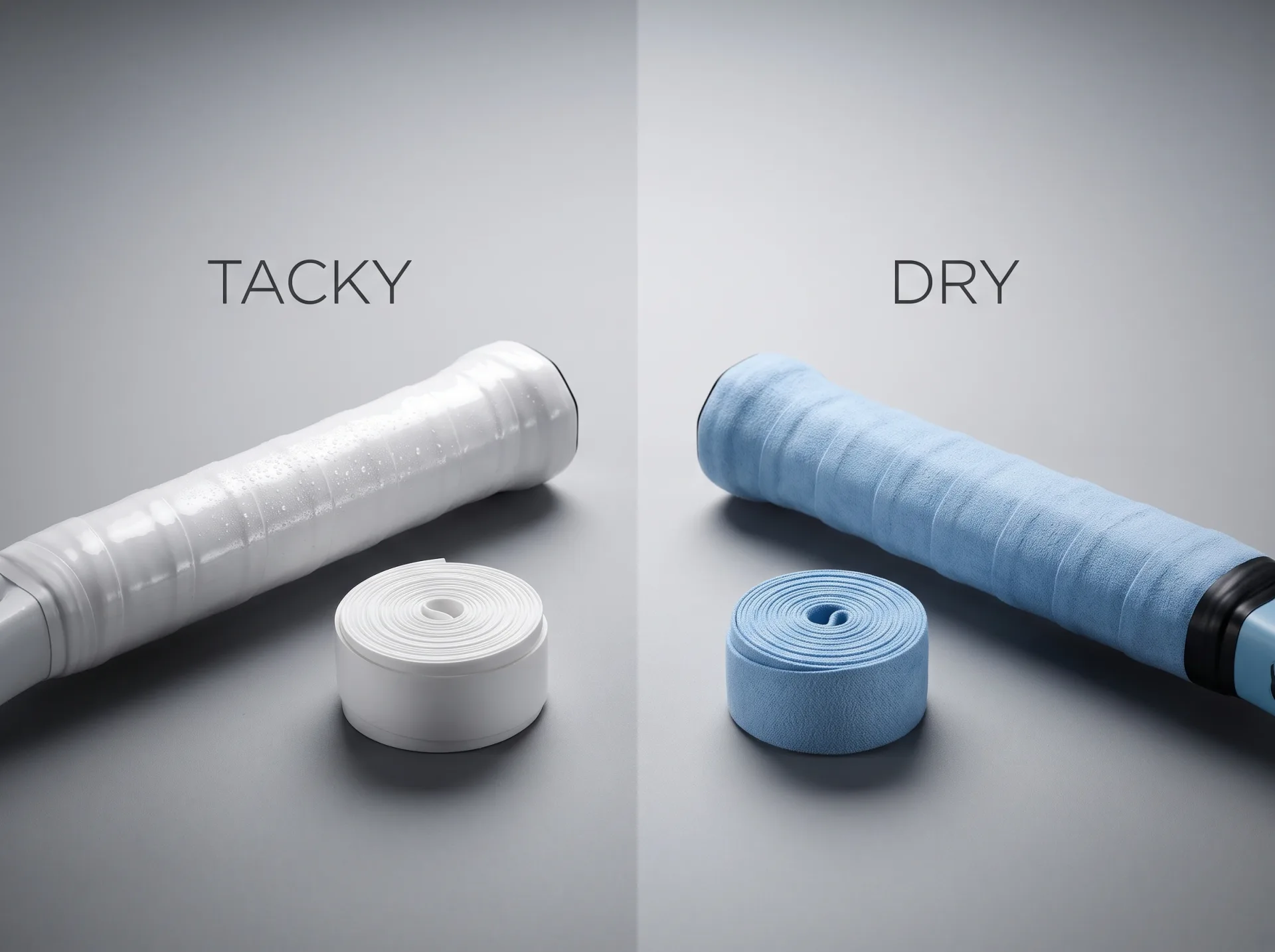
From our years of racket accessory manufacturing and customer feedback, the choice between tacky and dry overgrips comes down to matching feel, sweat behavior, and your target market:
- Choose a Tacky Overgrip if your players demand immediate, rubbery surface tack with maximum static stickiness right out of the wrap, play predominantly in dry-to-moderate climates with light-to-medium hand perspiration, and your target market is centered on players who prioritize a locked-in racket feel on short, explosive swings.
- Choose a Dry Overgrip if your players demand active moisture dispersion with a soft, non-slip cloth/suede texture, play regularly in hot, humid environments or suffer from heavy palm perspiration, and your target market serves tournament players and high-frequency athletes who prioritize consistent grip endurance over extended play sessions without turning slick.
1. Side-by-Side Performance Comparison
| Technical Parameter | Tacky Overgrip | Dry Overgrip |
|---|---|---|
| Surface Finish | Smooth / semi-gloss, rubbery stickiness | Matte, soft, suede/cloth-like texture |
| Initial Grip | High static friction immediately | Moderate, stabilizes with hand warmth & sweat |
| Sweat Response | Film adhesion; slick once saturated | Active capillary wicking into fibrous core |
| Functional Lifespan | 4–8 play hours | 8–15 play hours |
| Replacement Cycle | Every 1–2 sessions | Every 3–4 sessions |
| Target Climate | Dry to temperate, moderate humidity | Hot, tropical, high humidity (>70% RH) |
| Thickness Range | 0.50 mm – 0.60 mm | 0.40 mm – 0.60 mm |
| Standard Dimensions | 25 mm width × 1200 mm length | 25 mm width × 1200 mm length |
2. Practical Manufacturing Insights for Procurement
1. Handle Sizing Creep and Thickness Selection
In our production caliper tests, wrapping a standard 0.60 mm overgrip with a normal 2–3 mm overlap increases the effective handle circumference by 1.5 mm to 2.0 mm, roughly equal to a half-grip size (+0.5) expansion.
Production Case Study: Solving Grip Bulk for a Padel & Tennis Brand
In early 2025, a European racket brand experienced elevated customer returns after launching a 0.70 mm high-tack overgrip on their Size 2 (4 1/4") tennis and padel frames. Players reported that the grip felt bulky and blurred the octagonal bevels, hindering fast continental grip shifts during net volleys.
After testing grip cross-sections in our workshop, we adjusted the PU film and base substrate to a dense 0.50 mm profile with a tapered edge cut. This modification reduced circumference buildup from +2.2 mm down to +1.3 mm, preserving sharp bevel definition while maintaining the high-tack surface friction the brand required. Customer return rates dropped to under 0.5% on their subsequent 5,000-piece production run.
- Manufacturer Advice: For badminton rackets or small-handle frames (Sizes 0–2), specify 0.40 mm – 0.50 mm thickness to prevent bevel rounding. For standard tennis and padel play requiring extra cushion, the 0.60 mm thickness remains the versatile industry baseline.
2. Base Grip vs. Overgrip Clarification
Buyers often inquire about the "hybrid setup" used by professional players. When sourcing racket grips, it is critical to differentiate the base layer from the outer wrap:
- Replacement Grip (Base Grip): 1.5 mm – 1.8 mm thick, equipped with a full adhesive backing, applied directly onto the bare pallet to provide structural form and shock absorption.
- Overgrip: 0.4 mm – 0.8 mm thick, wrapped over the base grip as a replaceable, high-wear layer.
- Pro tour players rarely wrap two overgrips together. Instead, they pair a high-cushion, tacky replacement grip underneath with a thin, sweat-absorbing dry overgrip on top, ensuring handle stability without unwanted handle bulk.
3. Matching Inventory to Market Conditions
From years of fulfilling OEM orders worldwide, we advise allocating inventory according to regional climate and player behavior:
- For Humid/Coastal Regions & Summer Replenishment: Dry overgrips command high, consistent demand because sticky PU films saturate prematurely under constant perspiration.
- For Temperate/Inland Regions & Retail Shelves: Tacky overgrips naturally drive higher initial turnover because general consumers test grips primarily by touch, favoring instantaneous stickiness out of the packaging.
3. Factory Quality Control Standards
To prevent delamination and batch variance, standard factory inspection across our manufacturing runs includes:
- Peel & Adhesion Verification: Testing the bonding strength between the top PU film and the non-woven microfiber substrate under stretch tension to ensure zero surface peeling during aggressive play.
- Thickness & Width Tolerances: Digital caliper verification maintaining thickness tolerance strictly within ±0.02 mm and slitting width at 25 mm with clean cut edges.
- Moisture & Colorfastness Testing: Synthetic sweat immersion and friction testing to verify that polyurethane coatings do not hydrolyze prematurely and that finishing end tapes and custom printed branding do not bleed onto players' palms.
4. Frequently Asked Questions (FAQ)
Which overgrip is better: tacky or dry?
Neither is universally superior. Tacky overgrips provide immediate surface adhesion for dry conditions and low-to-medium sweating. Dry overgrips provide superior sweat absorption and steady grip stability for humid environments and heavy sweaters.
Do tacky overgrips wear out faster than dry overgrips?
Yes. In real-play conditions, tacky coatings typically lose surface tack within 4–8 play hours due to sweat and oil accumulation, whereas dry overgrips maintain steady non-slip performance for 8–15 play hours through mechanical moisture wicking.
How does overgrip thickness affect racket handling?
Standard 0.60 mm overgrips add roughly 1.5–2.0 mm to handle circumference (+0.5 grip size). For players with smaller hands or badminton frames requiring sharp bevel definition, specify 0.40–0.50 mm thickness.
What is the minimum order quantity (MOQ) for custom grip manufacturing?
At GRIPAVO, standard stock inventory in neutral packaging is available starting at 100 pcs MOQ. Custom OEM orders (custom Pantone colors, custom thickness, custom logo printing/embossing, and retail packaging) start at 1,000 pcs MOQ.
5. Technical Sourcing & Production Support
- Neutral Inventory Stock: Ready-to-ship standard specifications available starting at 100 pcs MOQ for rapid testing and low-risk market validation.
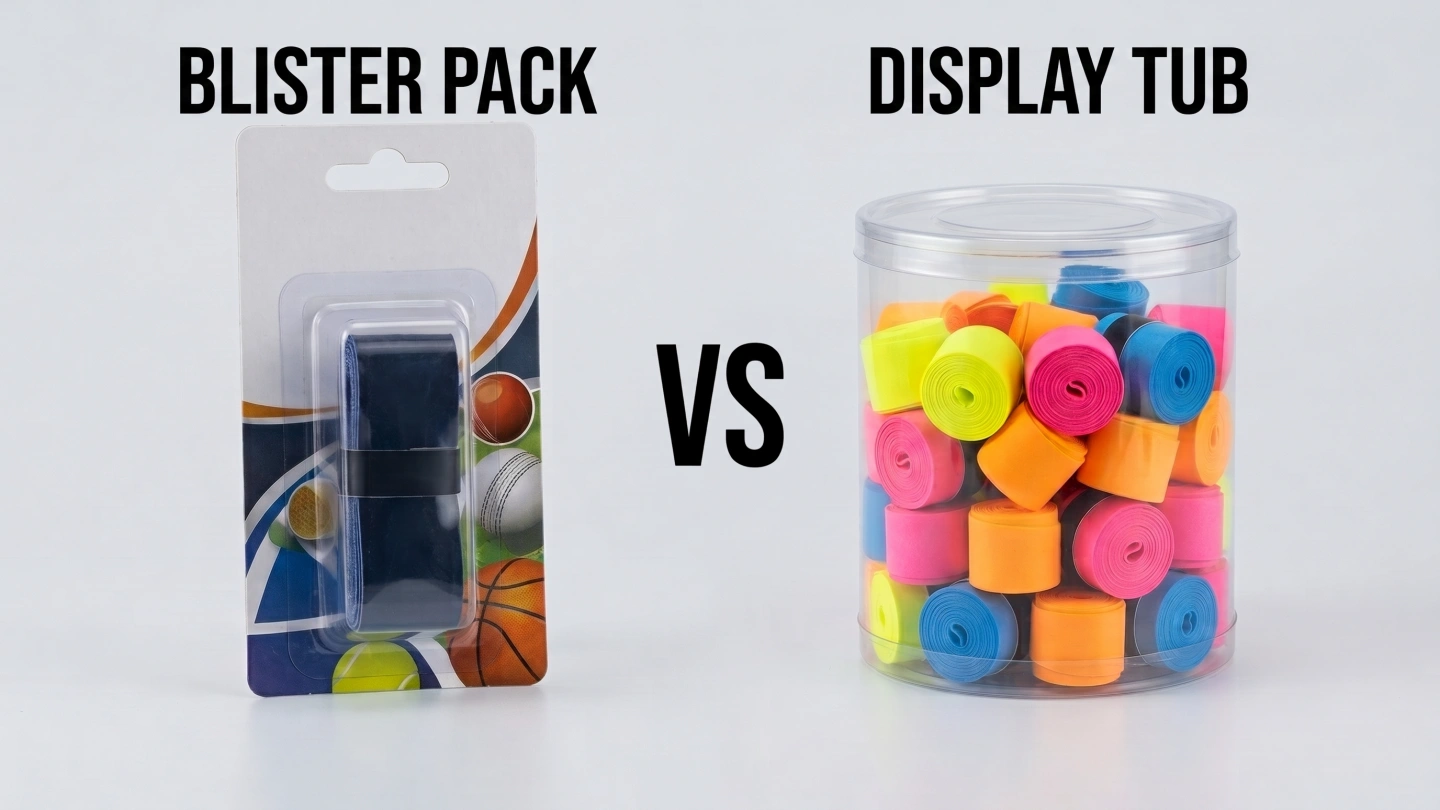
- Full OEM / Private Label Manufacturing: Tailored thickness (0.40 mm – 0.80 mm), custom width/length, branded finish tapes, 3D embossing, and retail packaging (blister cards, display tubs) starting at 1,000 pcs MOQ.
- Physical Sampling: Material swatch cards and testing rolls are available upon request for physical caliper measurement and traction testing (shipping freight covered by buyer).
Ready to finalize your technical specifications?
Contact our manufacturing team with your target sport, required thickness, and order volume to Request Technical Samples & OEM Quotation.